
Grading & Classification of Gynecomastia
Understand Your Condition Before Choosing the Right Treatment. Gynecomastia is not the same in every patient. The grade of gynecomastia helps your plastic surgeon determine the best surgical technique and expected outcome.

What Determines the Grade?
Gynecomastia is not the same in every patient. Some men have only a small amount of gland enlargement beneath the nipple, while others have severe breast enlargement with loose, sagging skin.
Your gynecomastia is classified based on these key factors:
At GynecomastiaSurgeryIndia.com and Star Hospital, Udaipur, every patient undergoes a detailed clinical examination before selecting the most appropriate treatment plan.
The grade of gynecomastia helps your plastic surgeon determine: the severity of breast enlargement, whether excess skin is present, the best surgical technique, whether liposuction alone is enough, whether gland excision is required, whether skin tightening or skin removal is necessary, expected scar pattern, recovery time, and final cosmetic outcome.
Simon's Classification (Most Widely Used)
This is the most accepted classification system worldwide. It classifies gynecomastia into four grades based on the amount of enlargement and skin excess.
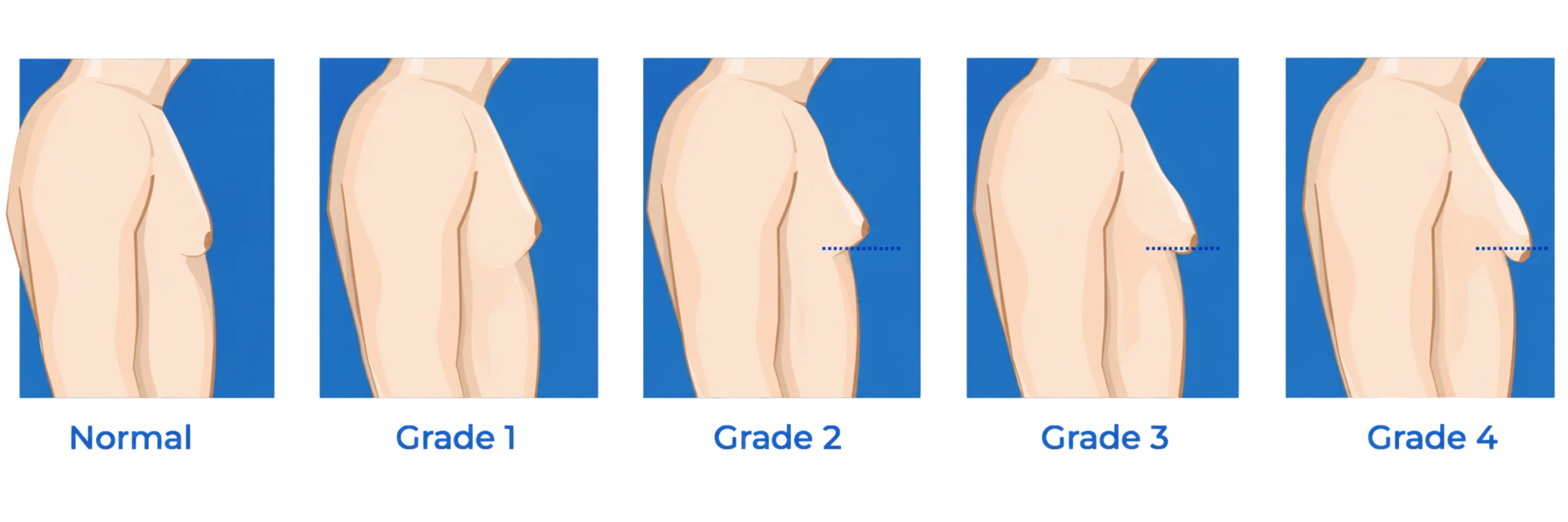
Grade I — Mild Enlargement
Without Excess Skin
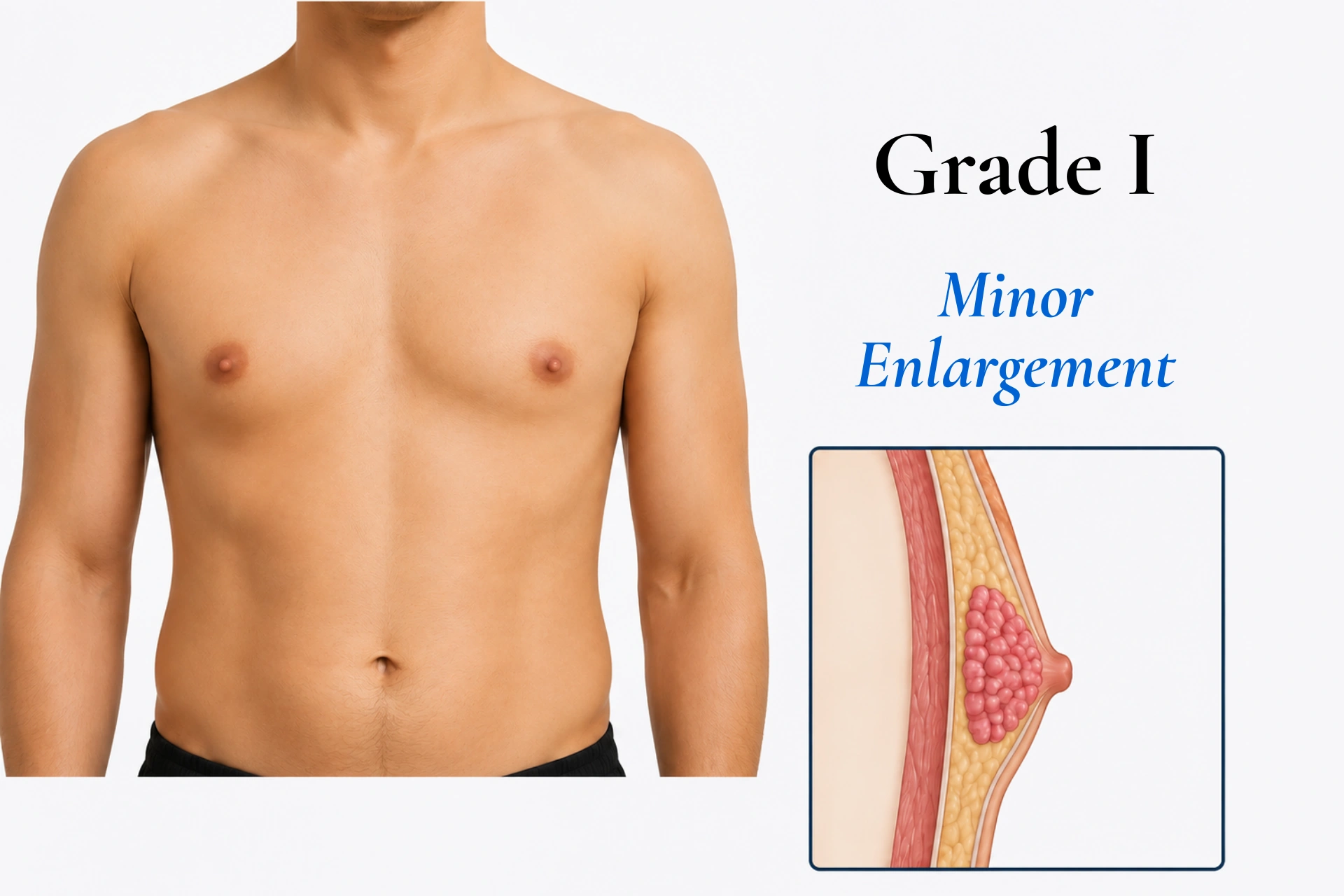
Grade I: Small gland beneath nipple · Normal chest contour when clothed
Features
- Small breast enlargement
- Localized gland beneath nipple
- No loose skin
- Puffy nipples are common
- Chest muscles remain visible
Appearance
The chest looks almost normal except for a small swelling beneath the nipple.
Common In
- Teenagers
- Young adults
- Gym enthusiasts
- Bodybuilders using supplements or steroids
Best Treatment
✔ Liposuction + gland excision through a tiny incision
Grade II — Moderate Enlargement
Without Excess Skin
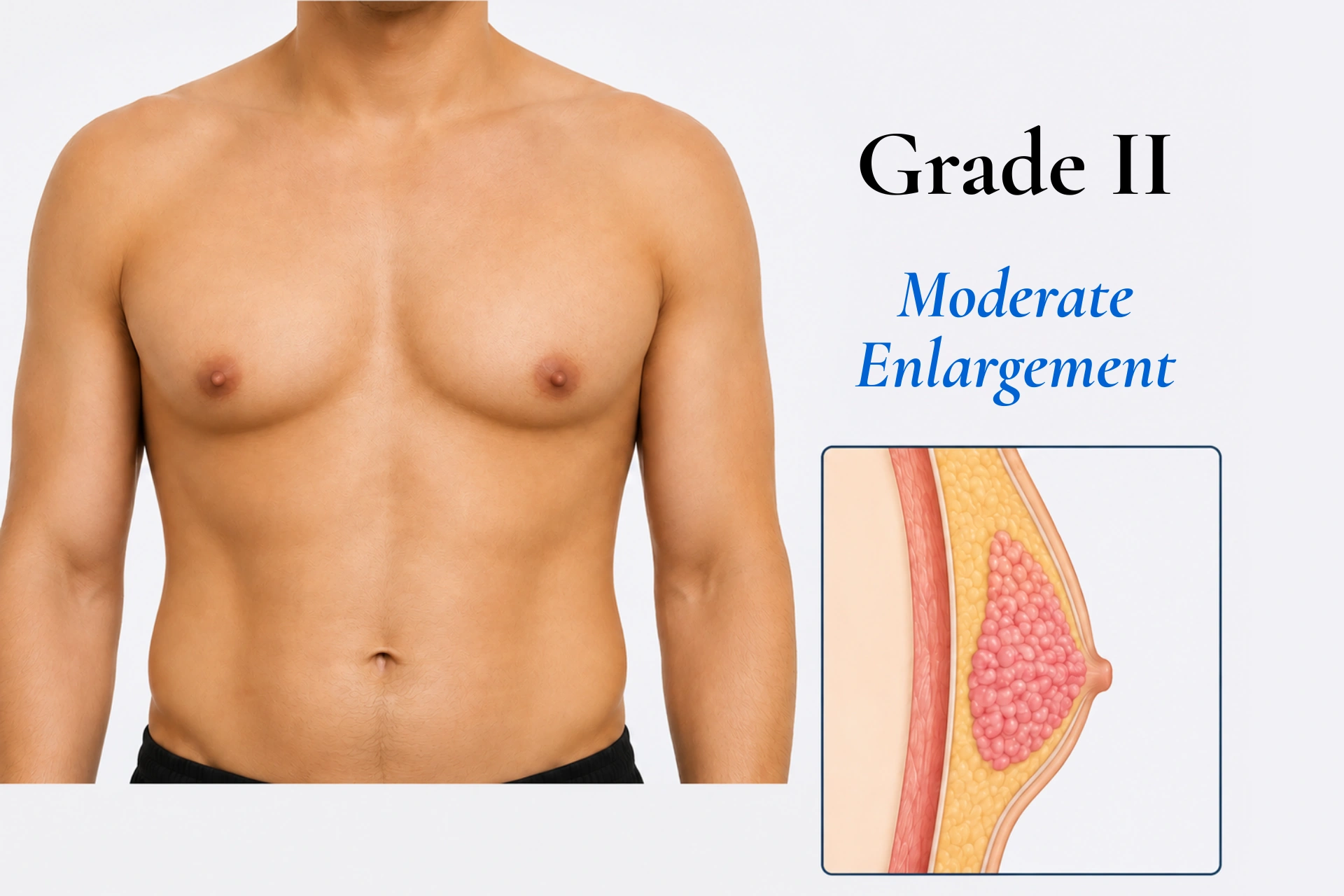
Grade II: Clearly visible breast contour · Good skin elasticity
Features
- Moderate breast enlargement
- Larger gland
- No significant skin excess
- Well-defined breast contour
- Skin still contracts well
Appearance
Breast is clearly visible even through clothing.
Best Treatment
- Liposuction
- Complete gland excision
- Body contouring
Grade III — Significant Enlargement
With Mild Skin Excess
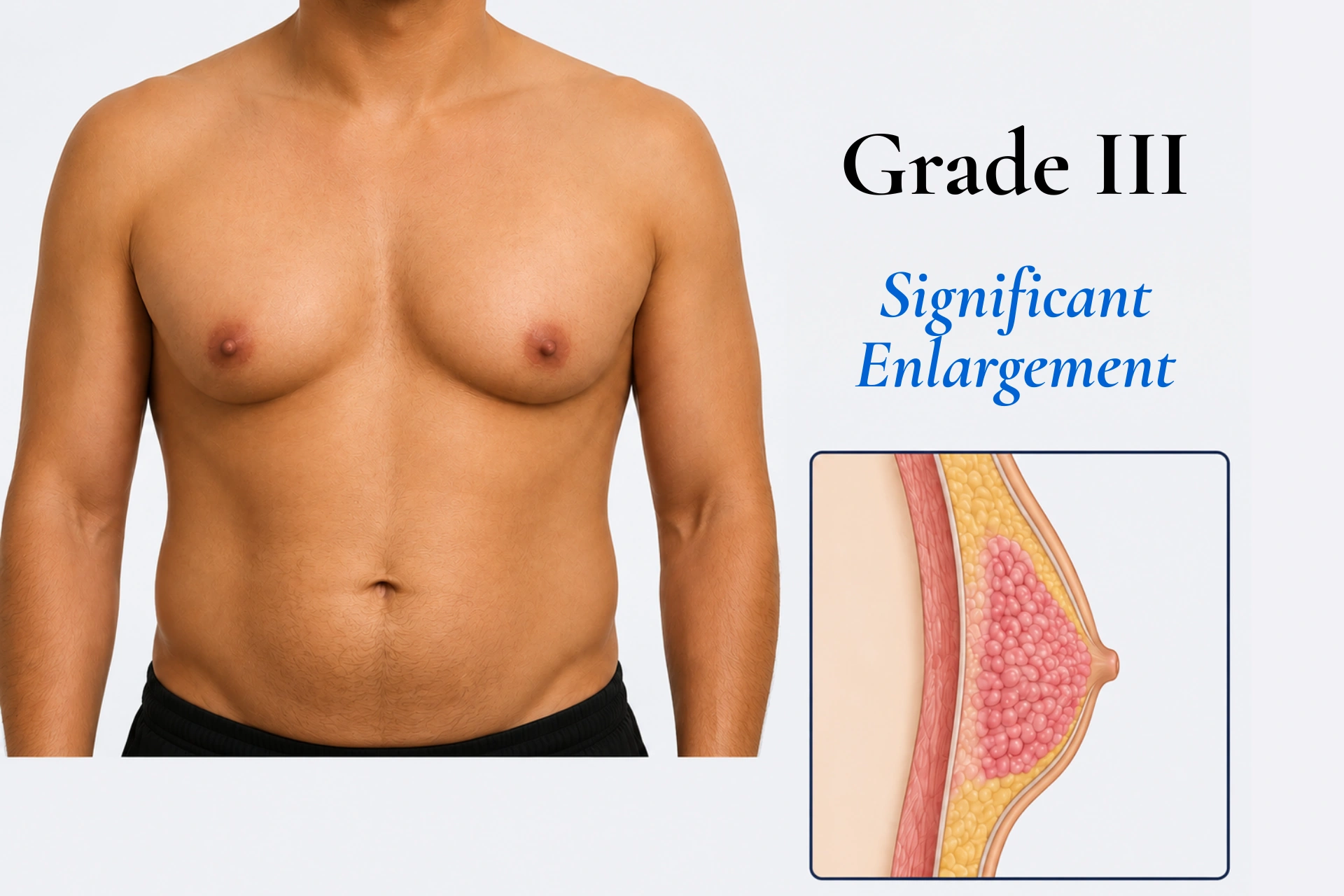
Grade III: Mild skin sagging · Nipple begins to descend
Features
- Moderate breast enlargement
- Mild loose skin
- Slight drooping
- Enlarged areola
- Nipple begins to descend
Appearance
Breasts remain noticeable even after weight loss.
Best Treatment
- Liposuction
- Gland excision
- Advanced skin tightening
- Occasionally limited skin excision
Grade IV — Severe Enlargement
With Significant Skin Excess
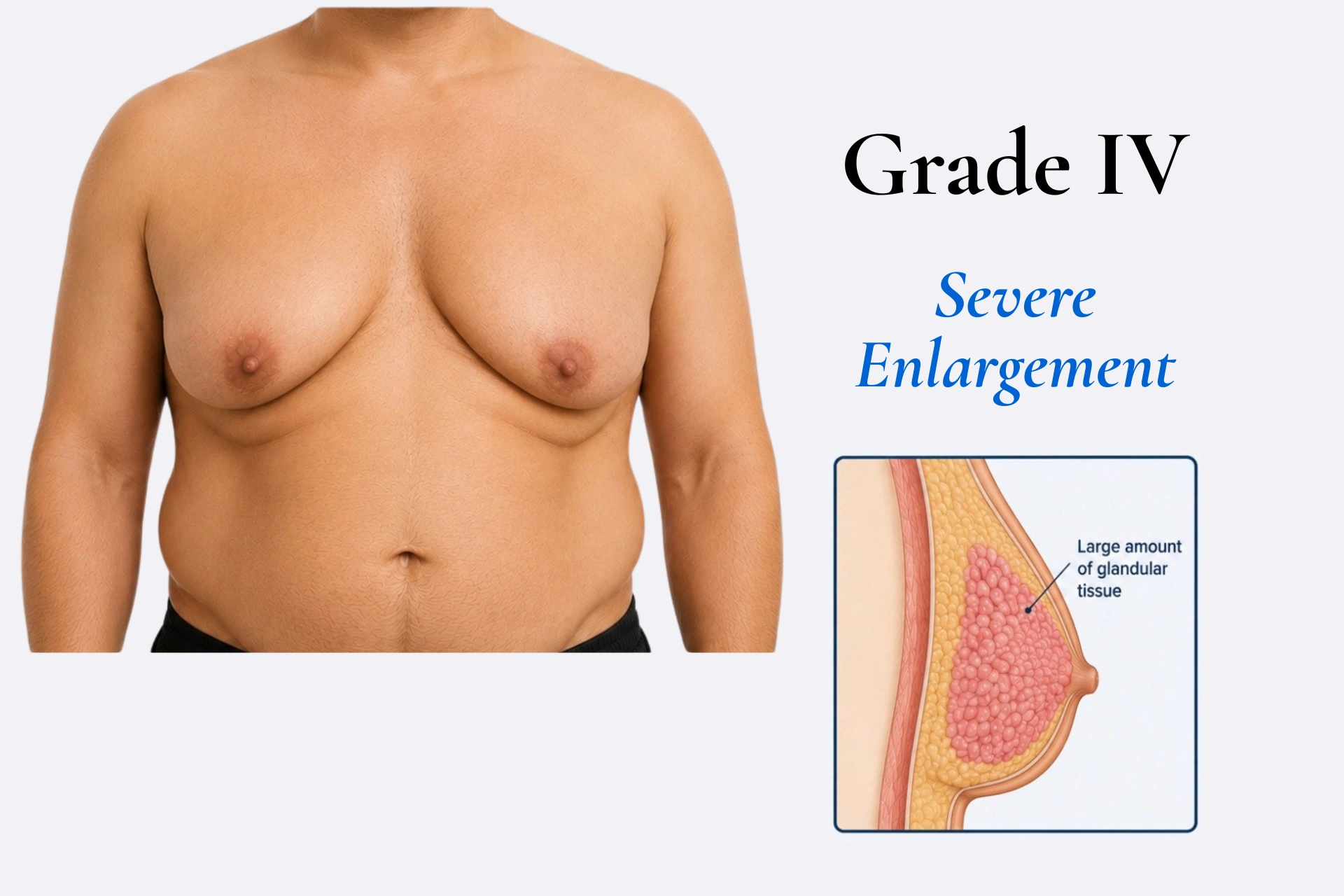
Grade IV: Large pendulous breast · Significant skin excess · Drooping nipple
Features
- Large male breasts
- Obvious loose skin
- Significant drooping
- Enlarged nipple-areola complex
- Poor skin elasticity
Appearance
Looks similar to a female breast.
Best Treatment
- Liposuction
- Complete gland removal
- Skin excision
- Chest contouring
- Nipple repositioning in selected cases
Rohrich Classification
Another useful system classifies gynecomastia according to the amount of fat, gland and skin. This system is especially useful for surgical planning.
| Grade | Description | Key Feature |
|---|---|---|
| Grade I | Small enlargement without skin excess | Minimal correction needed |
| Grade II | Moderate enlargement without skin excess | Good skin contractility |
| Grade III | Moderate enlargement with skin excess | Skin tightening may be required |
| Grade IV | Marked enlargement with severe skin excess | Skin excision essential |
Fat vs Gland vs Mixed Gynecomastia
Not every enlarged male chest is true gynecomastia. Understanding the tissue type is critical to selecting the correct treatment.
True Gynecomastia
Cause: Enlargement of breast gland tissue.
Feels like: Firm rubbery lump beneath nipple.
Treatment: Gland excision with liposuction
Pseudogynecomastia
Cause: Only excess fat.
Common in: Overweight and obese men.
Feels like: Soft fatty tissue.
Treatment: Weight reduction and liposuction
Mixed Gynecomastia
Contains fat, breast gland, and fibrous tissue. Most common type seen in clinical practice.
Treatment: Combination of liposuction and gland excision
Weight loss removes fat but does not remove enlarged gland tissue. Patients with true gynecomastia often continue to have puffy nipples or enlarged breasts even after significant weight reduction.
Classification Based on Cause
Gynecomastia may also be classified according to its underlying cause, which can influence treatment planning.
Physiological
- Newborn
- Puberty
- Older age
- Often improves naturally
Hormonal
Due to imbalance between estrogen and testosterone.
Drug-Induced
- Steroids
- Anti-ulcer medicines
- Anti-anxiety medicines
- Hormonal drugs
- Anti-cancer medicines
- Some heart medicines
Obesity-Related
Due to excess fat and increased estrogen production.
Disease-Related
- Liver disease
- Kidney disease
- Thyroid disorders
- Testicular disorders
- Tumors

Classification Based on Duration
Early Gynecomastia
- Less than 6 months
- Softer tissue
- Better response to medicines in selected patients
Chronic Gynecomastia
- More than 12 months
- Dense fibrous gland
- Surgery is usually the definitive treatment
Which Grade Needs Surgery?
| Grade | Surgery Usually Needed? | Skin Removal? |
|---|---|---|
| Grade I | Yes (if persistent) | No |
| Grade IIA | Yes | No |
| Grade IIB | Usually | Sometimes |
| Grade III | Yes | Often |
| Grade IV | Yes | Almost Always |
Unfortunately, no. Weight loss removes fat but does not remove enlarged gland tissue. Patients with true gynecomastia often continue to have puffy nipples or enlarged breasts even after significant weight reduction.

Why Correct Grading Matters
Proper grading helps your surgeon:
- Choose the safest surgical approach
- Minimize scars
- Achieve a flatter, masculine chest
- Preserve nipple sensation whenever possible
- Improve chest symmetry
- Reduce complications
- Deliver predictable cosmetic results
At GynecomastiaSurgeryIndia.com, every patient undergoes: detailed medical history, physical examination, grading using internationally accepted classifications, high-quality clinical photographs (with consent), personalized treatment planning, discussion of scars and expected outcomes, and an individualized recovery plan.
Our goal is to provide a natural-looking, masculine chest with the least possible scarring and a treatment plan tailored to your specific grade of gynecomastia.